Planning the day
Terracotta Army: when and how to go
Weather by season, Chinese holiday crowds, time slots, getting there, how long to allow and what each pit holds, checked against the museum's pages.
See Terracotta Army tickets & tours on Klook ↗Quick answer
The museum sells timed, capped tickets, so the day you choose matters more than the hour you arrive. Dry spring and autumn days are the easy ones for the walks between halls, and Chinese holiday weeks are the busiest. Book a slot ahead, arrive half an hour before it, and give the pits and Lishan Park a long half day. The museum's own pages don't give transport directions, so check your route before you set off.
Xi'an's seasons, in short
| Season | What to expect |
|---|---|
| Spring | Dry; March-April dust storms |
| Summer | Hot, humid, brief thunderstorms |
| Autumn | Dry; rain lasts to late October |
| Winter | Cold and dry |
Which season suits you
Xi'an has hot, humid summers, cold, dry winters, and dry springs and autumns. Most of its rain falls from July to late October, and dust storms are common in March and April. The largest pit sits under a roofed structure, so rain or cold doesn't stop a visit, but you still cross open squares between the halls and the entrance. That makes spring and autumn the easy seasons on paper. Summer works if you accept the heat and the rain, and winter works if you wrap up. The museum doesn't publish crowd levels by month, so we won't claim any.
Chinese holidays are the pinch point
China's Golden Weeks, around Spring Festival and National Day, have become peak seasons for travel and tourism, and the Labour Day break in May is also a longer holiday. The museum says it limits numbers, sells by time slot and spreads visitors out, and that its hours on major holidays follow its latest announcements. So on a holiday week, book as early as you can and check the museum's official channels for the current notice. If your dates are flexible, a plain weekday outside those weeks is the safest choice.
Read next: What you actually see at the Terracotta Army
Time slots and the day itself
Tickets are allocated by time slot, and the museum asks you to be at the gate half an hour before yours and to enter on time. Entry starts in the morning, and the last ticket check is earlier in the colder months, because the museum publishes two seasonal schedules. Your booking fixes your slot, so pick one that leaves you the rest of the day for the shuttle to Lishan Park and the second site. Entry is one way, through the North Gate.
How the day runs
Everyone enters through the North Gate, and the museum runs a one-way route in and out. Tickets are checked three times. When you leave the Terracotta Warriors Museum, you take the free shuttle bus from the Terracotta Warriors car park to Lishan Park, which the museum's page lists as the home of the Bronze Chariots and Horses Exhibition Hall and other burial pits. The same ticket is valid there on the same day. Because the shuttle sits between the two halves of the visit, it is easier to treat them as two stops than to try to rush one.
Getting there from Xi'an
The site is in Lintong District, just east of Xi'an. The museum's pages give no transport directions, and neither the museum's ticket nor a ticket-only booking includes a transfer. So choose your route before the day: a public bus, a taxi or ride-hailing car, a private driver, or a tour that includes the transfer. Whichever you pick, check the current route in a maps app or with your hotel, because routes and timetables change. Set your destination to the museum, and remember that the North Gate is the only way in.
Tour or on your own?
The deciding factors are transport and explanation, not access. A ticket-only booking gets you through the gate but not to it, and the museum's pages mention no guide service. A tour that includes the transfer removes the route-finding and usually adds commentary, but it fixes your hours around the group. Going on your own keeps the timing in your hands, as long as you book your slot and carry your passport. Whichever you choose, the museum's entry rules are the same: a named ticket, a time slot and an original ID.
How long to allow
The museum gives about an hour and a half for a visit. Its English text suggests that covers both the Terracotta Warriors Museum and Lishan Park, while its Chinese text reads as an hour and a half for each. Because the two sites are linked by a free shuttle bus from the Terracotta Warriors car park, and the same ticket is valid for both on the same day, a long half day is the realistic plan. Add time for the entry queue, the security check and the shuttle.
What each pit holds
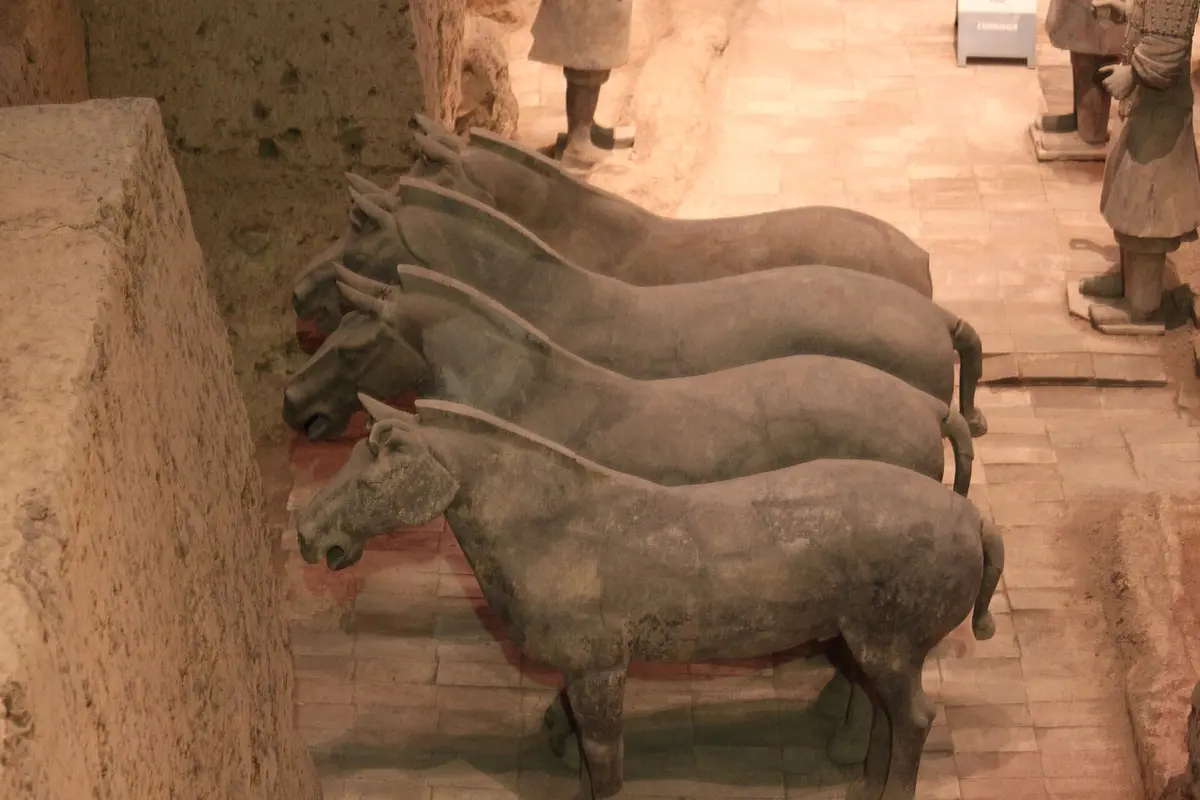
Pit 1 is the largest, with the army in long parallel corridors. Pit 2 is L-shaped and mixes crossbowmen, cavalry, infantry and chariots. Pit 3 is the smallest, with a layout the museum reads as the command post for Pits 1 and 2, and it is the only pit not burned in ancient times. That is why more of its original paint survived. In the other pits, much of the colour flaked off within minutes of the figures meeting the air. A fourth pit was found empty, so the army you see is in the three.
The tomb you won't see
The tomb mound itself has not been excavated. The pits lie about 1.5 kilometres east of it, and Lishan Park is the part of the site that surrounds the tomb. Heritage authorities have said research and a protection plan should come first. Soil around the mound has unusually high mercury readings, which some read as support for an ancient account of rivers of mercury inside. So the visit is the army, the bronze chariots and the surrounding archaeological park, not the burial chamber.
Families, wheelchairs and first aid
The museum's ticketing page lists wheelchairs and strollers at the Tourist Service Center, west of the North Square ticket gate, with details at the service counter. It describes dedicated routes for older, disabled and pregnant visitors and for people with large luggage, and a medical clinic south of the Pit 1 square after the second ticket check. Electric carts operate inside each of the two sites, with a separate fare at each. Children of foreign nationality up to 1.4 metres are eligible for free entry with a reservation.
Who this isn't for
If you need a spontaneous plan, this isn't an easy site: tickets are real-name, timed and booked ahead. If you want to see the emperor's burial chamber, it isn't open and has not been excavated. And if you have only an hour free on the day, the entry check, the security screening and the shuttle between sites will use much of it. Pick a day with at least half a day to spare.
Frequently asked questions
When is the best time to visit the Terracotta Army?
There's no single best month. Spring and autumn are dry, which helps with the open squares between halls. Avoid Chinese holiday weeks if you can, because the museum caps numbers and sells by time slot.
What is the weather like at the Terracotta Army?
Xi'an has hot, humid summers, cold, dry winters, and dry springs and autumns, with dust storms common in March and April. The largest pit is under a roof, so you can visit in any season.
Is the Terracotta Army busy during Chinese holidays?
Golden Weeks have become peak travel seasons in China. The museum limits numbers, sells time slots and says holiday hours follow its latest announcements, so book early and check its official notices.
How do I get to the Terracotta Army from Xi'an?
The site is in Lintong District, just east of Xi'an. The museum's pages give no directions, so choose a bus, taxi, private driver or tour with transfer, and check the current route before you go.
Can I visit without booking ahead?
Don't plan on it. The museum says all visitors must reserve and pre-purchase through its official channels, and every ticket is tied to a named person and a time slot.
Can I go inside the emperor's tomb?
No. The tomb mound has not been excavated. You see the three pits, the bronze chariots and the surrounding Lishan Park, which is part of the same ticket.
Sources